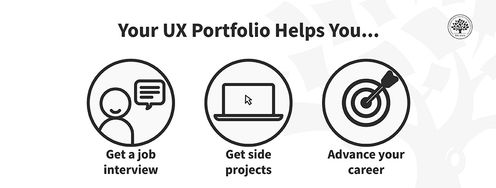
An illustration that demonstrates different UX specializations, in reference to a UX design portfolio.

Stop the Generic Portfolio Trap! Design a Stand-Out Portfolio for Your UX/UI Niche

• 42 min read

281 Shares

Your UX/UI portfolio is your ticket to your dream job, brief or client. It’s your opportunity to show off your expertise, creativity, and the tangible impact of your work. No matter your niche, your portfolio should be as innovative and polished as the projects it represents.

Think of your portfolio as your personal design project—it needs a clear strategy, attention to detail, and a focus on user experience to make an impact.

In UX design, every mistake is a learning opportunity. Watch this video with Morgane Peng, Design Director at Societe Generale CIB, to uncover common pitfalls and learn how to avoid them—set your portfolio up for success from the start.

Transcript

With that foundation, you’re ready to take your portfolio even further. Here’s how to tailor your portfolio to different UX/UI niches so that it stands out from the competition.

UX Writing: The Power of Words in Design
© Interaction Design Foundation, CC BY-SA 4.0

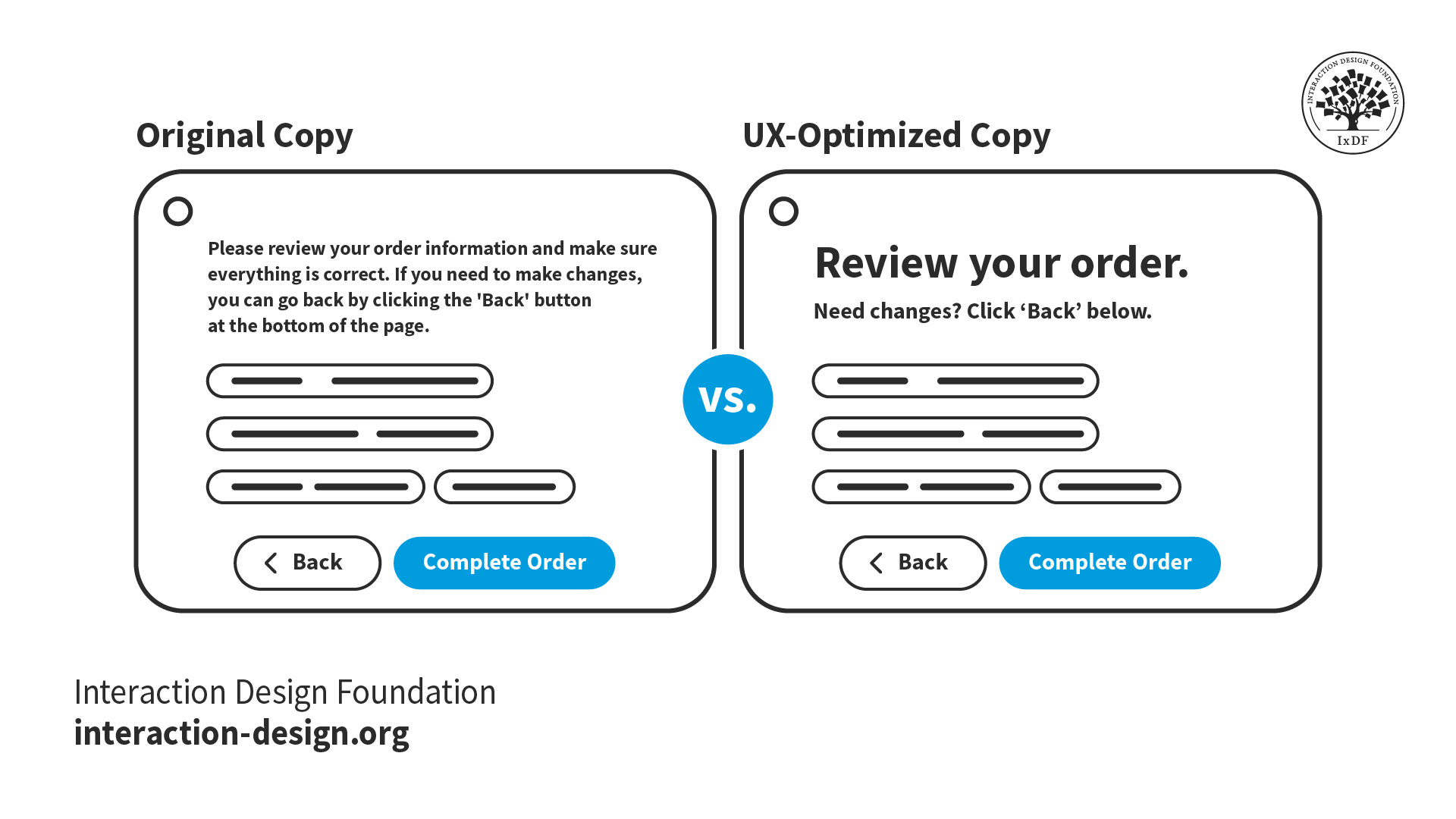
A well-crafted UX writing portfolio proves that words matter. Focus on case studies that demonstrate how your microcopy clarifies user interactions, reduces friction, and guides users through complex flows.

  • Structure your work around problem-solving: Present projects that highlight challenges, your role in crafting solutions, and measurable outcomes, such as improved conversion rates or reduced errors.

  • Showcase versatility: Include examples like onboarding flows, error messages, or content strategy for complex interfaces.

  • Collaborate and iterate: Emphasize teamwork with designers and developers, and show how feedback refined your copy.

Make your portfolio user-friendly—clear navigation and concise explanations mirror the UX writing principles you apply in your work.

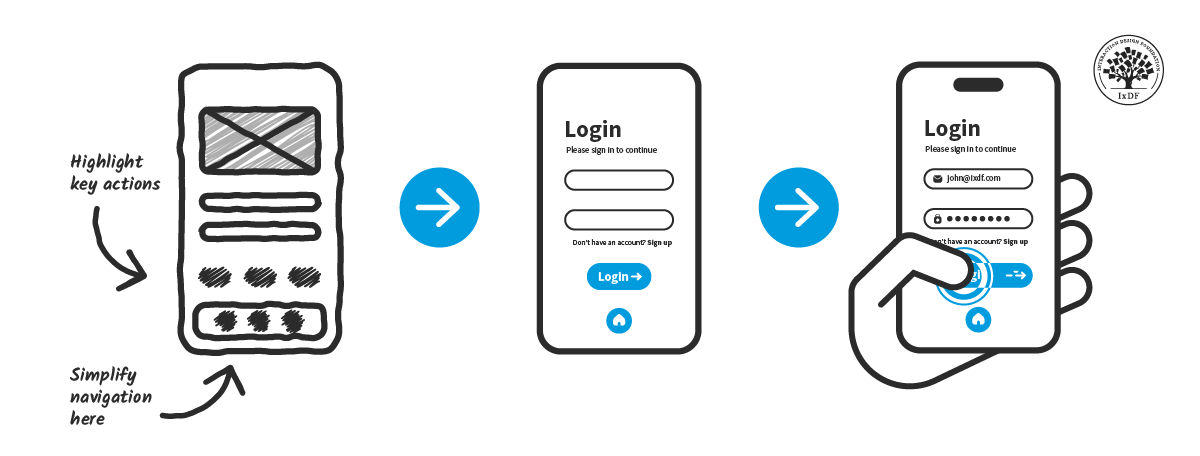
UI Design: Where Aesthetics Meet Usability
© Interaction Design Foundation, CC BY-SA 4.0

A great UI portfolio balances visual appeal with usability. Hiring managers want to see more than polished screens—they want to understand your process and the impact of your designs.

  • Highlight problem-solving: Include case studies where your designs addressed issues like poor navigation or low engagement.

  • Bring your process to life: Use annotated sketches, journey maps, and prototypes to demonstrate your iterative process.

Increase your chances of getting noticed by tailoring your portfolio to specific roles. Show hiring managers the projects in your portfolio they need to see to know you’ll be the right person for the job. For instance, if you’d like to apply for mobile-focused design positions, emphasize responsive design, or if you’d like to apply for SaaS roles, showcase your complex dashboards design experience.

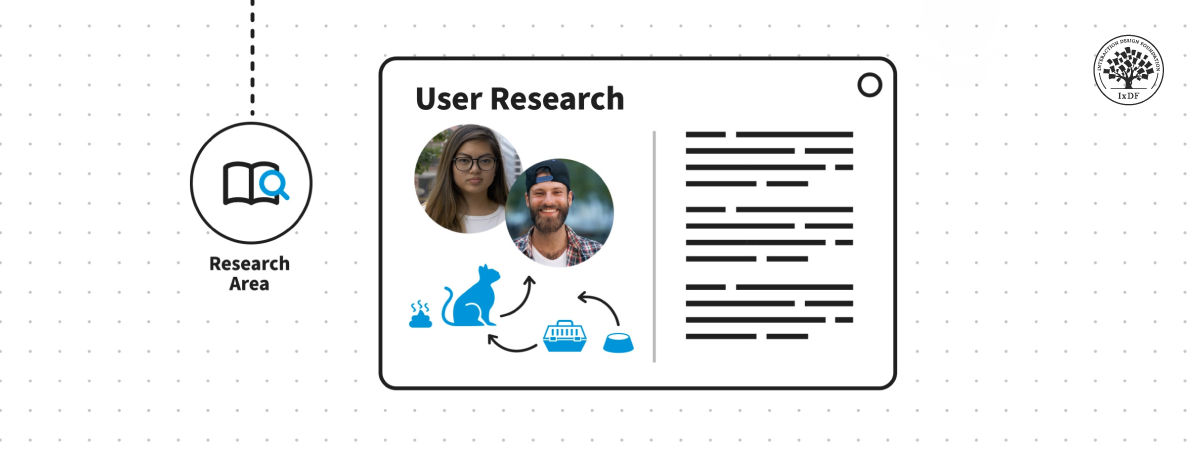
User Research: Turn Insights Into Action
© Interaction Design Foundation, CC BY-SA 4.0

User research portfolios should showcase how your insights directly improved design decisions and user experiences.

  • Show your methodology: Highlight diverse research methods like surveys, interviews, usability testing, or diary studies.

  • Illustrate impact: Use case studies to demonstrate how your findings informed design changes, reduced drop-off rates, or improved user satisfaction.

  • Collaborate effectively: Detail how you worked with designers and stakeholders to turn insights into actionable strategies.

Visual aids such as empathy maps or journey maps help communicate your findings and make your process memorable.

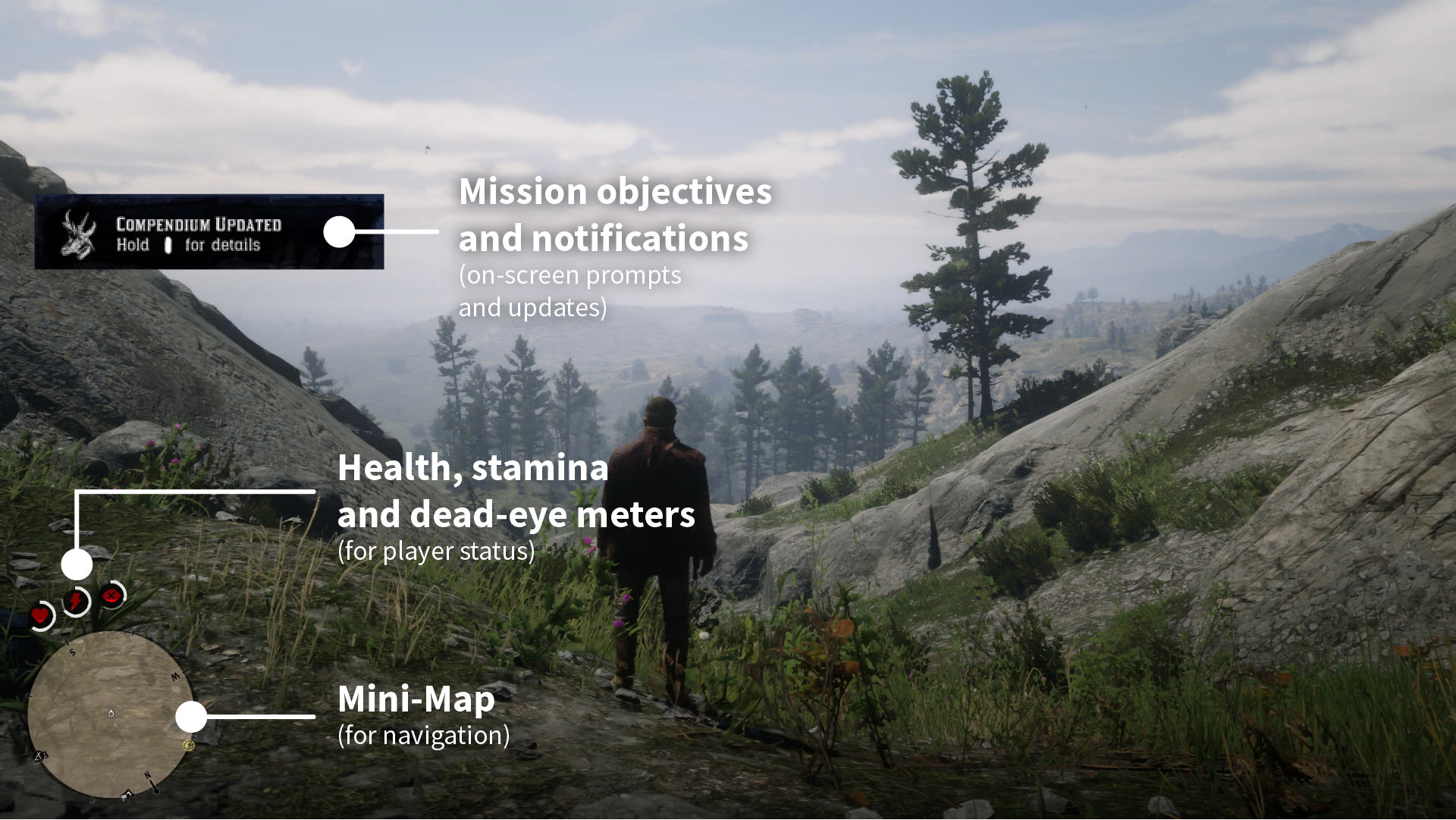
Game UX: Enhance Player Experience
© Interaction Design Foundation, CC BY-SA 4.0

© Interaction Design Foundation, CC BY-SA 4.0

Game UX portfolios should use storytelling to demonstrate the innovative nature of the work being highlighted. Show how your work addresses unique gameplay challenges, improves player engagement, and enhances immersion.

  • Highlight key challenges: Did you simplify complex mechanics, reduce player frustration, or refine tutorials? Use detailed case studies to share your process.

  • Showcase collaboration: Explain how you worked with game designers and developers to create cohesive experiences.

  • Focus on player feedback: Include insights from playtests and the metrics that highlight your impact, such as reduced drop-off rates or increased session times.

Use visuals like annotated screenshots, HUD refinements, and interactive prototypes to showcase your work effectively.

Proven Strategies for Any Portfolio

No matter your niche, these tips will help your portfolio shine:

  • Use storytelling: Craft compelling narratives that walk viewers through your process, challenges, and solutions.

  • Include real-world impact: Share metrics, user feedback, and testimonials that demonstrate the success of your work.

  • Design your portfolio as an experience: Apply UX principles to make your portfolio intuitive, visually appealing, and easy to navigate.

Gain insights from design leaders like Vitaly Friedman, Pablo Stanley, and Niwal Sheikh as they share what truly stands out in a portfolio.

Transcript

The Take Away

A generic portfolio won't cut it in today’s competitive UX/UI landscape. To rise above the competition, tailor your portfolio to emphasize your niche—demonstrate your expertise, adaptability, and the tangible results of your work. Whether you simplify user flows, design intuitive interfaces, uncover user insights, or enhance player experiences, your portfolio should highlight your unique ability to solve problems and deliver real value.

Show the story behind your work—the challenges you faced, the decisions you made, and the results you achieved. Prioritize storytelling to create an emotional connection, highlight collaboration to demonstrate your teamwork, and include measurable outcomes to prove your impact. With a compelling, results-driven portfolio, you present yourself as a designer (no matter what the specialty) hiring managers and clients can’t afford to overlook.

References and Where to Learn More

Want to create a portfolio that gets you hired? Take our course, Build a Standout UX/UI Portfolio: Land Your Dream Job, and learn how to showcase your skills, tell compelling project stories, and impress employers.

Read the following articles:

  • Stop the Generic Portfolio Trap! Design a Stand-Out Portfolio for Your UX/UI Niche: UX Writing

Learn More in This Course:

Personas and User Research: Design Products and Services People Need and Want

1
12
45
52
99 % booked
View Course

What You Should Read Next

  • Read full article
    Use Circular Design To Reverse Harm - Article hero image
    Interaction Design Foundation logo

    Use Circular Design To Reverse Harm

    Nature is circular. Nothing ever goes to waste. The banana peel we discard degrades into nutritious compost for plants. Even the remains of deceased animals and humans disintegrate into the soil. Human engineering and design, on the other hand, are linear processes. And that has put us on a one-way

    Social shares
    421
    Published
    Read Article
  • Read full article
    Recycling is Not Enough. Let's Design for Reuse - Article hero image
    Interaction Design Foundation logo

    Recycling is Not Enough. Let's Design for Reuse

    “We live in the age of technology and luxury, but we also live in the age of waste,” Don Norman explains. In this video, the grandfather of User Experience Design, Don Norman unpacks the world of waste we have collectively generated. He examines aspects of our daily lives that we take for granted an

    Social shares
    455
    Published
    Read Article
  • Read full article
    Tree Testing: A Complete Guide - Article hero image
    Interaction Design Foundation logo

    Tree Testing: A Complete Guide

    Tree Testing reveals where users lose their way in your navigation. It’s a focused approach to evaluate a site's navigational structure. But it’s more useful in certain scenarios—so, you need to understand where you’ll benefit from tree testing the most. Learn about the pros and cons of testing tool

    Social shares
    685
    Published
    Read Article
  • Read full article
    How to Design Ethically: Expert Advice from Guthrie Weinschenk - Article hero image
    Interaction Design Foundation logo

    How to Design Ethically: Expert Advice from Guthrie Weinschenk

    As UX designers, we wield immense power to influence our users’ lives. We have the dual responsibility of catering to the interests of our users, as well as that of our sponsors (employers, clients and other business stakeholders). This can sometimes put designers in uncomfortable situations and rai

    Social shares
    544
    Published
    Read Article
  • Read full article
    Anything Artificial We Can Design Better - Article hero image
    Interaction Design Foundation logo

    Anything Artificial We Can Design Better

    If you look out the window, you’ll realize many things you see are artificial—buildings, cars, parks, electricity posts, water pipes, etc.—and most of those things were designed by humans. Founding father of UX, Don Norman introduces you to artificiality and how designers shape the world.[[video:142

    Social shares
    407
    Published
    Read Article
  • Read full article
    Enter the World of Social VR - Article hero image
    Interaction Design Foundation logo

    Enter the World of Social VR

    Our metaverse is big—as in massive and expanding, to be more exact—and there’s plenty of room to trailblaze inside of all of that digital space, so if virtual reality (VR) can teleport, catapult, and integrate human users into brand-new worlds of excitement, discovery, and learning (which it can, by

    Social shares
    560
    Published
    Read Article
  • Read full article
    8 Talks by Women to Inspire UX Designers - Article hero image
    Interaction Design Foundation logo

    8 Talks by Women to Inspire UX Designers

    User Experience design, like so many other disciplines, has a lower representation of women as compared to men. Things are changing now, though. Slowly, but surely. From strategy to tactics and from ideas to actionable tips, here is a curated playlist of talks by, and stories of just some of the mos

    Social shares
    657
    Published
    Read Article
  • Read full article
    UX Storyboards: Ultimate Guide - Article hero image
    Interaction Design Foundation logo

    UX Storyboards: Ultimate Guide

    In user experience design, we use techniques like workshops and interviews to understand users. We turn our research into user stories and process flows. We use personas and wireframes to share our ideas with our teams.But it’s important to remember the real people we design for. We need to know wha

    Social shares
    781
    Published
    Read Article
  • Read full article
    Top 6 Tips to Make Your UX Portfolio Stand Out - Article hero image
    Interaction Design Foundation logo

    Top 6 Tips to Make Your UX Portfolio Stand Out

    Whether you’re a UX designer looking for your first UX job or a seasoned designer looking to further your career, your UX portfolio is arguably one of the most important projects you’ll work on. Your portfolio is the first touchpoint you have with the recruiters; it’s your chance to make an impactfu

    Social shares
    707
    Published
    Read Article
  • Read full article
    3 Reasons Why Accessible Design Is Good for All - Article hero image
    Interaction Design Foundation logo

    3 Reasons Why Accessible Design Is Good for All

    Most designers probably agree that accessibility matters: We want to create designs and interfaces that don’t exclude users with disabilities. There are plenty of obvious moral reasons that accessibility matters, but, unfortunately, accessibility considerations are often one of the first things to g

    Social shares
    767
    Published
    Read Article

Top Articles

Top Topic Definitions

Feel Stuck?
Want Better Job Options?

AI is replacing jobs everywhere, yet design jobs are booming with a projected 45% job growth. With design skills, you can create products and services people love. More love means more impact and greater salary potential.

At IxDF, we help you from your first course to your next job, all in one place.

See How Design Skills Turn Into Job Options
Privacy Settings
By using this site, you accept our Cookie Policy and Terms of Use.
Customize
Accept all

Be the One Who Inspires

People remember who shares great ideas.

Share on:

Academic Credibility — On Autopilot

Don't waste time googling citation formats. Just copy, paste and look legit in seconds.

Feel stuck? Want Freedom?

Get one powerful email each week, like 322,805 others.

Learn to design a life you love.

Next email in: